
NASA Mission Control Simulator

Build. Innovate. Explore.

Tackle real-world challenges using NASA's data, and turn ideas into impact.

LEO 400 KM ORBITAL FEED
🛰️ REAL-TIME 3D TELEMETRY
🖱️ Click & Drag to Rotate in 360° • Scroll to Zoom
🚀

Choose a Challenge

Sentinel-Earth Climate Monitor
Stormwatch Scratchtory
Artemis Lunar Resource
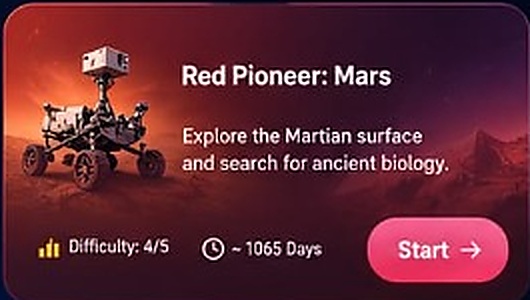
Red Pioneer: Mars Exploration Probe
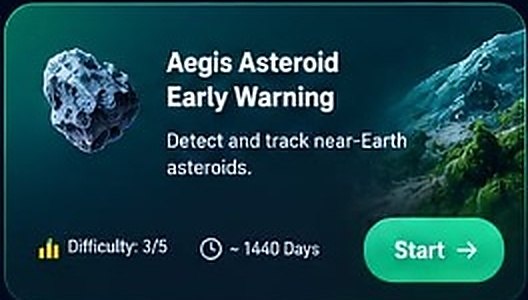
Aegis Asteroid Early Warning
DeepView Cosmic Dawn Space

🎮 Multiplayer Co-Op

Server Online
🚀

Create Mission Room

Rocket Launch Pad
👥

Join Mission Room

International Space Station
📖

FLIGHT CREW OPERATIONS GUIDE

How to play real-time cooperative NASA space missions with your crew

1
Host or Join Mission
Create a room with your callsign & target destination, or enter the 6-character Room Code (or invite link) to join friends.
2
Choose Your Station
Claim 1 of 4 specialized flight consoles: Flight Director, Propulsion Engineer, Lead Science Officer, or Comms Specialist.
3
GO / NO-GO Poll
Verify sub-systems and click "Toggle Ready". When all stations are Green, Flight Director starts the synchronized T-0 launch.
4
Fly & Solve Anomalies
Steer ascent, burn thrusters [W/S], scan planetary data [SPACEBAR], broadcast radio intercom, and resolve red-team alarms together!

FLIGHT OPERATIONS TEAM ASSIGNMENT

Assign mission personnel and designate specialized discipline leads

SELECT MISSION OBJECTIVE

Choose an operational science directive from the NASA Science Mission Directorate

SENTINEL-EARTH CLIMATE MONITOR — DESIGN STUDIO

NASA Systems Engineering & Subsystem Sizing

LIVE 3D SPACECRAFT CAD / BLUEPRINT INSPECTOR
🖱️ Drag Rotate 360° • Scroll Zoom
⛁ BUS: NONE ⚡ PWR: NONE 📦 PAYLOAD: 0 UNITS
AWAITING HARDWARE INTEGRATION — SELECT BUS & SUBSYSTEMS BELOW

⛁ SELECT MISSION ORBITAL REGIME

Orbital altitude and inclination govern science observation opportunities, ground pass geometry, delta-V requirements, and the radiation environment.

SPACECRAFT BUS STRUCTURE

Defines the structural backbone, payload mass limit, and physical deck capacity.

PROPULSION SUBSYSTEM

Provides delta-V for orbital insertion, trajectory correction maneuvers (TCM), collision avoidance, and end-of-life disposal.

ELECTRICAL POWER SUBSYSTEM (EPS)

Generates electrical energy for avionics and instruments. Solar arrays degrade in radiation and attenuate with solar distance.

ATTITUDE DETERMINATION & CONTROL SYSTEM (ADCS)

Controls spacecraft orientation. High-resolution optical telescopes and spectrometers require sub-arcsecond fine guidance.

COMMAND & DATA HANDLING (C&DH)

Central flight computer and radiation-hardened mass memory storage.

THERMAL CONTROL SUBSYSTEM (TCS)

Maintains sensitive electronic and detector temperatures within operational limits.

TELEMETRY ANTENNA

Antenna gain and aperture size determine RF link budget and beam directional requirements.

RF FREQUENCY BAND

Higher frequencies (X/Ka) unlock massive data throughput but demand tighter pointing.

GROUND STATION SEGMENT

Ground contact passes per day determine how many hours the spacecraft can dump telemetry.

SCIENTIFIC INSTRUMENT PAYLOAD (MULTI-SELECT)

Choose instruments to fulfill your mission objectives. Watch mass, power consumption, data generation, and pointing requirements!

LAUNCH VEHICLE SELECTION

Verify rocket payload lift capacity to your chosen orbit and consider booster reliability.

🛠️ CUSTOM SPACECRAFT DESIGN STUDIO

NASA Systems Engineering • Build, Customize & Fly Your Own Satellite

FLIGHT READINESS REVIEW (FRR)

Final NASA engineering board verification prior to launch commitment

SPACECRAFT SYSTEMS SPECIFICATION

ENGINEERING GO / NO-GO CHECKLIST

VERIFYING HARDWARE COMPATIBILITY...

🎮 3D SPACE FLIGHT SIMULATION

Interactive 3D Simulation • Drag mouse to rotate view • Scroll to zoom

MET (MISSION ELAPSED TIME) Day 0 / 730
SCIENCE DATA RETURN 0.0 pts
DOWNLINK TELEMETRY 0 GB
POWER BUS EFFICIENCY 100%
SPACECRAFT HEALTH 100%
NOMINAL FLIGHT OPERATIONS
📡 REAL-TIME MISSION TELEMETRY LOG ● LIVE

NASA POST-FLIGHT MISSION EVALUATION

Systems Engineering Assessment & Scientific Return Debrief

A OVERALL GRADE
92 / 100 PTS
🔬 Science Return (Max 40) 36 / 40
⚙️ Systems Engineering (Max 25) 23 / 25
💰 Fiscal Efficiency (Max 20) 18 / 20
⏳ Operational Longevity (Max 15) 15 / 15

MISSION COMMENDATIONS

OFFICIAL NASA MISSION REPORT

NASA SYSTEMS ENGINEERING & MISSION DESIGN GUIDE

Fundamental principles of aerospace trade studies and spacecraft subsystems

1. The Core Systems Engineering Challenge

Every space mission is an intricate balance of competing physical constraints. No single subsystem can be optimized in isolation without penalizing another:

  • More Instruments: Increases science discovery, but drives up mass, power demands, radio data rates, and total cost.
  • Higher Orbit (e.g. GEO or L2): Eliminates atmospheric drag and expands field of view, but drastically reduces the payload mass a rocket can deliver.
  • Larger Solar Arrays: Generate more power, but introduce structural mass penalties and attitude-pointing drag.

2. Key Spacecraft Subsystems

🛰️ Spacecraft Bus

The structural skeleton that protects avionics, supports mounting brackets, and bears launch acoustic loads.

⚡ Power Subsystem (EPS)

Triple-junction solar cells or RTG nuclear power. Note that solar irradiance follows the inverse-square law (\(1/r^2\)) at Mars.

🎯 Attitude Determination & Control (ADCS)

Reaction wheels and star trackers that point cameras at targets with arcsecond precision and maintain antenna alignment.

📡 Telecommunications

RF carrier links (UHF, S, X, Ka-band) and directional high-gain antennas to downlink data to ground stations.

3. Flight Readiness & Evaluation Rubric

Before liftoff, missions undergo a rigorous Flight Readiness Review (FRR). Missions are scored across four key pillars:

  • Science Return (40%): Fulfillment of specific mission objectives, sensor diversity, and observation quality.
  • Systems Engineering (25%): Health of mass and power margins, pointing stability alignment, and launcher reliability.
  • Fiscal Efficiency (20%): Completing objectives within designated budget envelopes without over-spending.
  • Operational Longevity (15%): Maintaining spacecraft health through solar flares, debris risks, and component aging.